Computational Physics Question Card
按知识点组织的题卡:RNG / 蒙特卡洛 / 分布式计算 / Julia 实现要点。
1. RNG
- What is Mersenne number? what is Mersenne prime number ?
\(M_n = 2^n-1\), when \(M_n\) is prime
-
What is the advantage and disadvantage of multiplicative RNG and additive RNG?
multiplicative simpler, faster, not good sequence
additive complex, slower, better sequence
-
How many RNG algorithm do you remember?
congruential, lagged fibonacci RNG
Congruential
- What is Congruential RNG? Is it additive or Multiplicative?
\(x_i = (cx_{i-1})\text{mod}p\), multiplicative
- What's the max period or congruential RNG? When achieve it?
\(p-1\), when \(p\) is a Mersenne prime number , \(c^{p-1}mod~p = 1\)
Lagged Fibonacci
- What is Lagged Fibonacci RNG? Is it additive or Multiplicative?
\(x_{i+1} = (x_{i-c}+x_{i-d})\text{mod}2\), \(c,d\in\{1,\cdots,i-1\},d\le c\) additive
- How to generate the initial sequence before \(c\)
use a congruential generator
- What's the max period?
\(2^c - 1\)
- What condition should the parameter \(c,d\) satisfy? and the smallest number for it?
$T_{c,d}(z) = 1+z^c + z^d $ (Zieler Trinomial)cannot be factorized, (250,103)
How good is RNG?
- What kind of method could be used to measure RNG?
square test, cube test, \(\chi^2\) test, average value, spectral analysis, serial correlation test
- What is square test?
\((s_i,s_{i+1})\forall i\) , no cluster means good
- What is cube test?
\((s_i,s_{i+1},s_{i+1})\forall i\), should be distributed homogenously
- What is \(\chi^2\) test
the distribution around the mean value should behave like a Gaussian distribution
- What is average test?
\(\underset{N\to \infin}{lim}\frac{1}{N}\sum_{i=1}^N s_i = \frac{1}{2}\quad\forall s_i\in[0,1]\)
- What is spectral analysis?
\(\mathcal F(s)\) should correspond to a uniform distribution
Quasi Monte Carlo
- What is quasi Monte Carlo approches?
use low-discrepancy sequence for Monte Carlo sampling
- What is the error bounds in quasi-Monte Carlo? is the error bounds deterministic?
\(\mathcal O(\frac{log(N)^d}{N})\) \(d\) is the problem dimension, \(N\) is number of sampling,yes
- What is the error of Monte Carlo sampling? When quasi MC is better than MC?
\(\mathcal O(\frac{1}{\sqrt{N}})\), number of samples is large enough
- What is the advantage of quasi MC?
quasi MC better convergence as \(N\) increase, and error bounds is deterministic
Discrepancy and low-discrepancy sequence
-
What is D-star discrepancy? $$ D^*(x_1,\cdots,x_n) = \underset{0\le v_j\le 1,j=1,\cdots,d}{sup}\left|\frac{1}{N}\sum_{i=1}N\prod_{j=1}d 1_{0\le x_j^i\le v_j} - \prod_{j=1}^d v_j\right| $$ for every subset \(E\) of \([0,1]^d\) get the biggest difference between the volume and average points density.
-
How to judge if a sequence \(x_1,\cdots,x_n\in[0,1]^d\) is a low discrepancy sequence? $$ D^*(x_1,\cdots,x_n)\le c(d)\cdot\frac{log(N)^d}{N} $$
Non Uniform Distribution
- What are two method to perform transformation?
mapping, rejection method
-
How do mapping work for unit sphere from \(X,Y\sim\text{Unif}(0,1)\)? $$ \begin{aligned} \int_0X\int_0Y 1dxdy &= \frac{1}{4\pi}\int_0\Theta\int_0\phi \text{sin}\phi d\phi d\theta \ XY &= \frac{1}{4\pi}(1-\text{cos}\phi)\theta \ \theta &= 2\pi X\ \phi &= \text{arccos}(1-2Y) \end{aligned} $$
-
How do mapping work for exponential distribution?
the exponential distribution is defined as \(P(y) = ke^{-yk}\) $$ \begin{aligned} \int_0 ^ y ke^{-y'k}dy' &= \int_0^z P_u(z')dz' = z\ z &= 1-e^{-yk}\ y &= -\frac{1}{k}ln(1-z) \end{aligned} $$
- How do mapping work for gaussian? (Box-Muller transform)
the gaussian distribution is written as \(P(y) = \frac{1}{\sqrt{\pi\sigma}}e^{-\frac{y^2}{\sigma}}\) $$ \begin{aligned} z_1z_2 &= \int_0{y_1}\int_0e}\frac{1}{\pi \sigma{-\frac{y_1'2 + y_2'^2}{\sigma}}dy_1'dy_2' = \frac{1}{\pi\sigma}\int_0^\phi \int_0^r e{-\frac{r'2}{\sigma}}r'dr'd\phi' \ &= \frac{\phi}{2\pi}(1-e{-\frac{r2}{\sigma}}) = \underset{z_1}{\underbrace{\frac{1}{2\pi}arctan(\frac{y_1}{y_2})}}\underset{z2}{\underbrace{(1-e{-\frac{y_12+y_2^2}{\sigma}})}} \ y_1 &= \sqrt{-\sigma ln(1-z_2)}sin(2\pi z_1)\ y_2 &= \sqrt{-\sigma ln(1-z_2)}cos(2\pi z_1) \end{aligned} $$
- What condition should transformation method satify?
integrability, invertibility
- How to make rejection faster?
individual box(Riemann-integral)
Speedup
- What is the Amdahl's law?
\(T(p) = (\alpha + \frac{1-\alpha}{p})T(1)\) ,\(\alpha\) is the sequential part, \(p\) is the speed up ratio
- How many methods do you know in Julia for parallel programming?
asynchronous, multi-threading, distributed, gpu
2. Percolation
- What is the main goal of percolation?
study the formation of clusters
- What are two types of percolation?
site/bond percolation
- What is percolated ?
as occupation rate \(p\) go to some point, cluster size will go to infinite (phase transition)
Phase Transition
- What name is the phase transition occuring in percolation?
second-order phase transition
- What is the percolation strength, and it's definition near at $p=1 $ and \(p<p_c\)
infinite cluster \(P(p<p_c) = 0\), \(P(p=1)=1\) , \(P(p\gtrsim p_c)\sim|p-p_c|^\beta\) ,\(\beta\) is percolation strength/order parameter, it strongly depends on the problem
- which lattice has the highest 2d threshold \(p_c\) site and \(p_c\) bond ?
honeycomb
- what is wrapping probability?
the probability system is percolated. \(W(p)=0~if~p<p_c~else~1\)
Cluster Size Distribution
- What is cluster size distribution? $$ n_s(p) = \underset{L\to\infin}{lim}\frac{N_s(p,L)}{L} $$ \(p\) : occupation probability
\(L\) : system's side length
\(N_s(p,L)\) : number of clusters of size \(s\)
- What phenomenon will you find for cluster size distribution with different \(p\)?
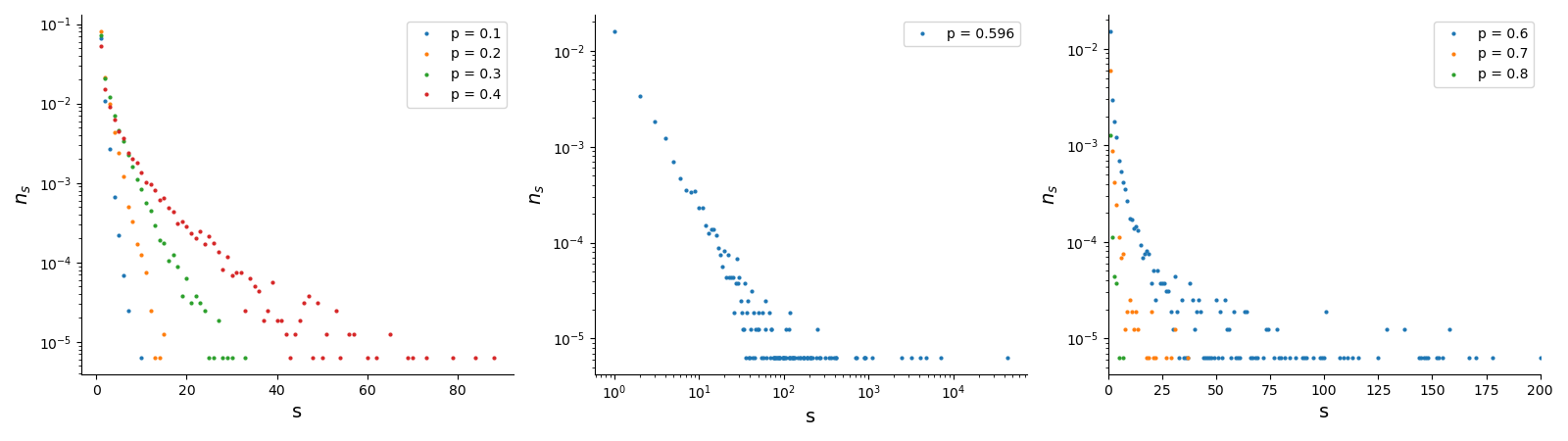
\(p<p_c\), as \(p\uparrow\) , \(s-ln(n_s)\) are higher
\(p=p_c\), straight line
\(p > p_c\), as \(p\uparrow\), \(s-ln(n_s)\) are lower
- What do you observe in the \(\chi^2\) test for the cluster size? (\(\chi=\sum_s s^2\frac{N_s}{N_{clusters}}\))
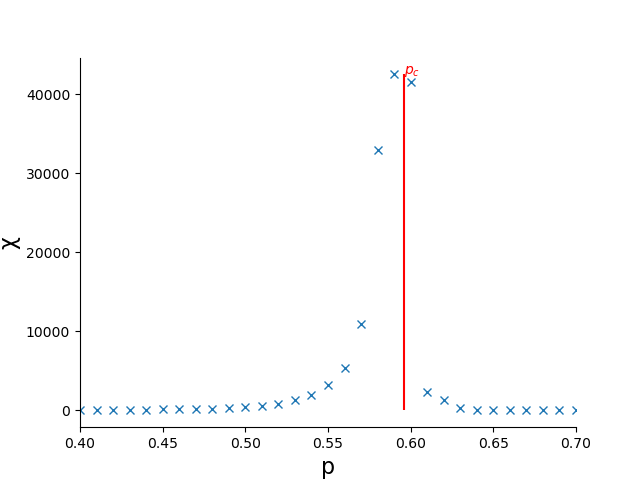
There is a spike near \(p_c\)
Burning Method
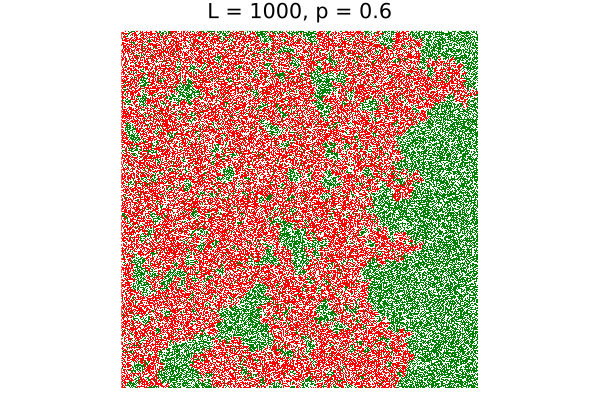
- What information can burning method provide?
a boolean feedback(yes or no percolated),
minimal path length
- Write a short code for burning method
def burning_method(L=16):
    lattice = np.random.randint(0, 2, (L, L)) # 0 empty 1 occupied
    t = 2
    lattice[0][lattice[0]==1] = t
    while True:
        cells = np.where(lattice == t)[0]
        burn_neighbor = False
        for cell in cells:
            for neighbor in neighbors[cell]:
                if neighbor == 1:
                    lattice[neighbor] = t+1
                    burn_neighbor = True
        if not burn_neighbor
         break
        t += 1
- How to count the largest cluster size of a random generated lattice?
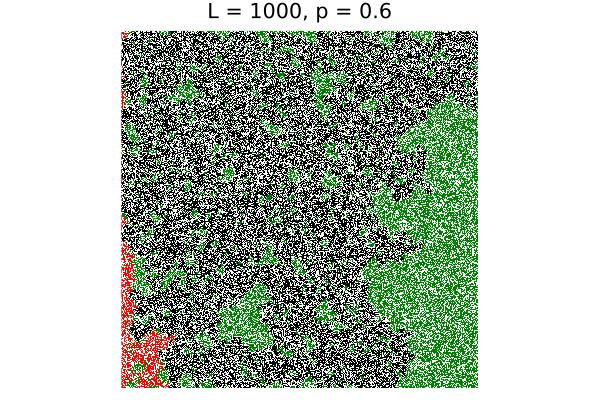
similar to the burning algorithm but from another side.
Hoshen-Kopelmann Algorithm
- What is the Hoshen-Kopelman used for?
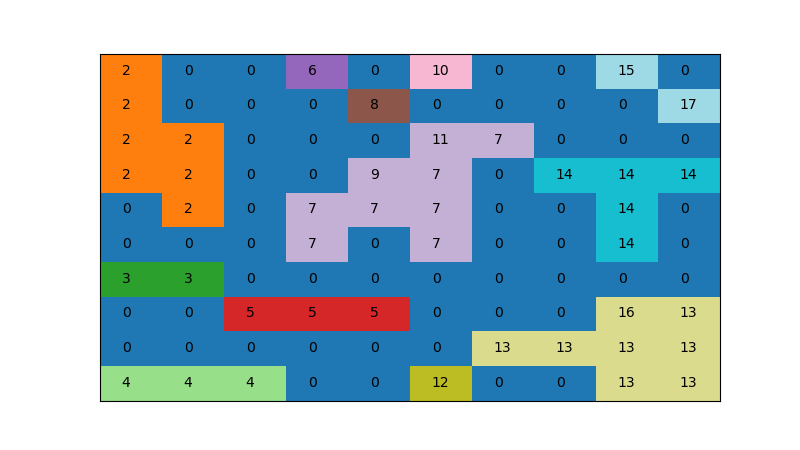
know how the different clusters are distributed
- What is the complexity of Hoshen-Kopelman Algorithm?
linear to the number of sites
- Write a short code for Hoshen-Kopelmann algorithm
def hoshen_kopelmann(L=16):
    lattice = np.random.randint(0, 2, (L, L))
    M = np.array([0,0]) # cluster counter
    for i in range(L):
        for j in range(L):
            if lattice[i,j] == 1:
                if no_left(i,j) and no_top(i,j): # no left and no top neighbor
                    lattice[i,j] = len(M);
                     M = np.append(M, 1)
                elif no_left(i,j) ^ no_top(i,j): # either left or top neighbor
                    k0 = lattice[i-1,j] if no_left(i,j) else lattice[i, j-1]
                    lattice[i,j] = k0
                    M[k0] += 1
                else: # has left and top neighbors
                    k1, k2 = lattice[i-1, j], lattice[i, j-1]
                     lattice[i,j] = k1
                    M[k1] = M[k1] + M[k2] + 1
                    M[k2] = -k1
3. Fractal
-
what is the fractal dimension? $$ \underset{\varepsilon\to 0}{lim}\frac{V_\varepsilon*}{\varepsilond} = \left(\frac{L}{\varepsilon }\right)^{d_f} \quad d_f = \underset{\varepsilon\to 0}{lim}\frac{\text{log}(V*/\varepsilond)}{\text{log}(L/\varepsilon)} $$ for fractal dimension \(a^{d_f}\), if the length is stretched by factor of \(a\), it's volume(mass) grows by \(a^{d_f}\)
-
What is the fractal dimension of Sierpinski triangle?
\(\frac{\text{log}(3)}{\text{log}(2)} \approx 1.585\)
Sandbox method
- Write a short code for sandbox method
def sandbox(lattice):
    R_2s   = np.arange(1,lattice.shape[0] // 2) # half size of R
    NRs    = np.zeros_like(R_2s)
    Rs     = R_2s * 2
    for i,R_2 in enumerate(R_2s):
        NRs[i] = lattice[R_2:-R_2,R_2:-R_2].sum()
    plot_log_log(NRs, Rs)
growing boxes from center
- what is the slope of the log-log plot (\(N(R)-R\)) of sandbox method
fractal dimension \(d_f\)
Box counting method
- write a short code for box counting method
def box_counting(lattice):
    epsilon = lattice.shape[0]
    N_epsilons = []
    epsilons   = []
    while epsilon >= 1:
        N_epsilon = maxpool2d(lattice, epsilon).sum()
        epsilon = epsilon // 2
    plot_log_log(N_epsilons,epsilons)
- what is the slope of the log-log plot (\(N(R)-R\)) of box counting algorithm
fractal dimension \(d_f\)
Fractals & Percolation
-
What is the correlation function \(c(r)\) ? And what does the expression mean? $$ c® = \frac{\Gamma(d/2)}{2\pi{d/2}r[M(r+\Delta r)-M®] $$ }\Delta r\(c(r)\) counts the filled sites within a \(d\) dimension hyper shell of thick \(\Delta r\) with radius \(r\) and normalize by the surface area
-
What is the common relation for \(c(r)-r\)
\(c(r)\) decrease exponentially with \(r\) , \(c(r)\propto C+exp\left(-\frac{r}{\xi}\right)\) , \(\xi\) is correlation length, propotional to the radius of a typical cluster
- When is correlation \(\xi\) singular?
\(\xi\) is singular at \(p_c\), \(\xi\propto |p-p_c|^{-\nu}\) where \(\nu=\begin{cases}4/3&d=2\\0.88&d=3\end{cases}\)
- How does \(c(r)\) behave when \(\xi\) is singular?
\(c(r)\propto r^{-(d-2+\eta)}\), where \(\eta=\begin{cases}5/24&d=2\\-0.05&d=3\end{cases}\)
- What's the relation between the fractal dimension \(d^f\) and dimension \(d\) ?
\(d^f = d - \frac{\beta}{\nu}\)
4. Cellular Automata
- Illustrate the components \(\mathcal L,\psi, R,\mathcal N\) defining a cellular automata
\(\mathcal L\): lattice, \(\psi(\textbf{r},t)\): state of each site \(\textbf{r}\) at time \(t\) , \(R\) update rules, \(\mathcal N\): neighbors
- What is the synchronous dynamics?
\(R\) rules applied simultaneously to all sites
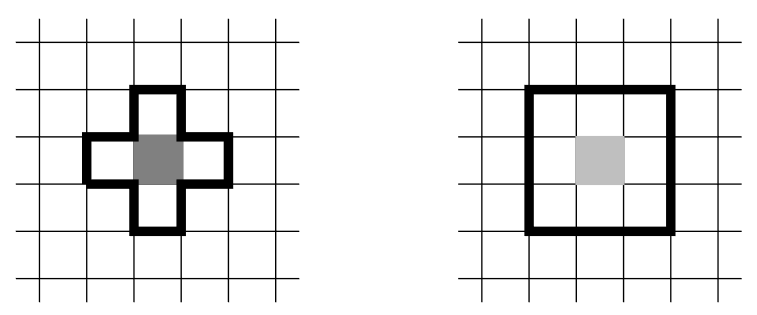
- What's the difference between Von Neumann neighborhood and Moore neighborhood?
Von Neumann: 4, Moore: 8
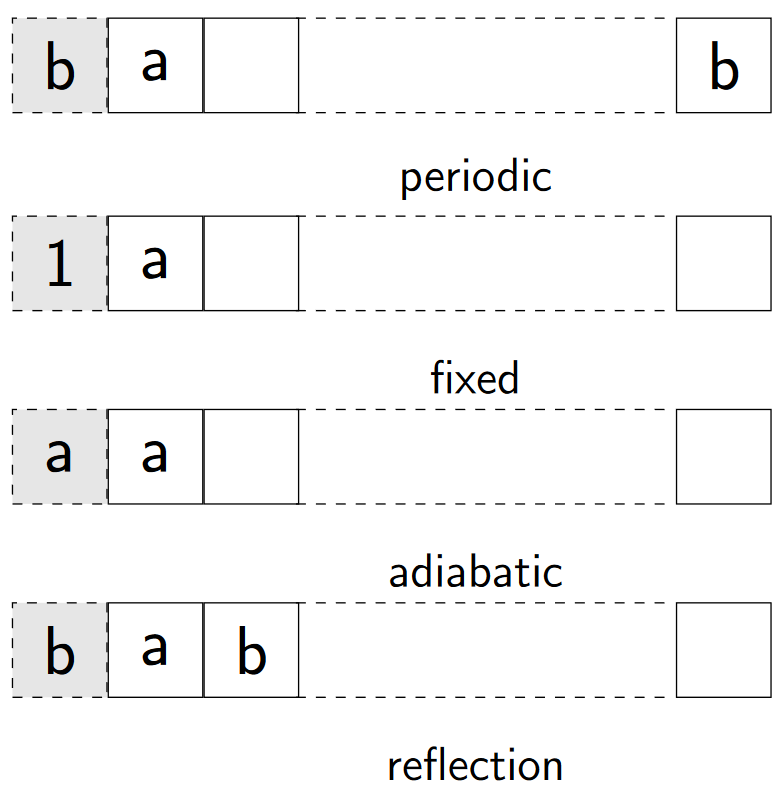
- What's the four types of boundaries?
periodic, fixed, adiabatic, reflection
Game of Life
- What is the neighborhood for Game of Life?
Moore neighborhood
- What's the rule \(R\) for Game of Life ?
| neighbors | action |
|---|---|
| \(n<2\) | dead, because of isolation |
| \(n=2\) | unchange |
| \(n=3\) | birth |
| \(n>3\) | dead, because of over population |
- List some periodic pattern in Game of Life
| pattern | animation |
|---|---|
| glider | 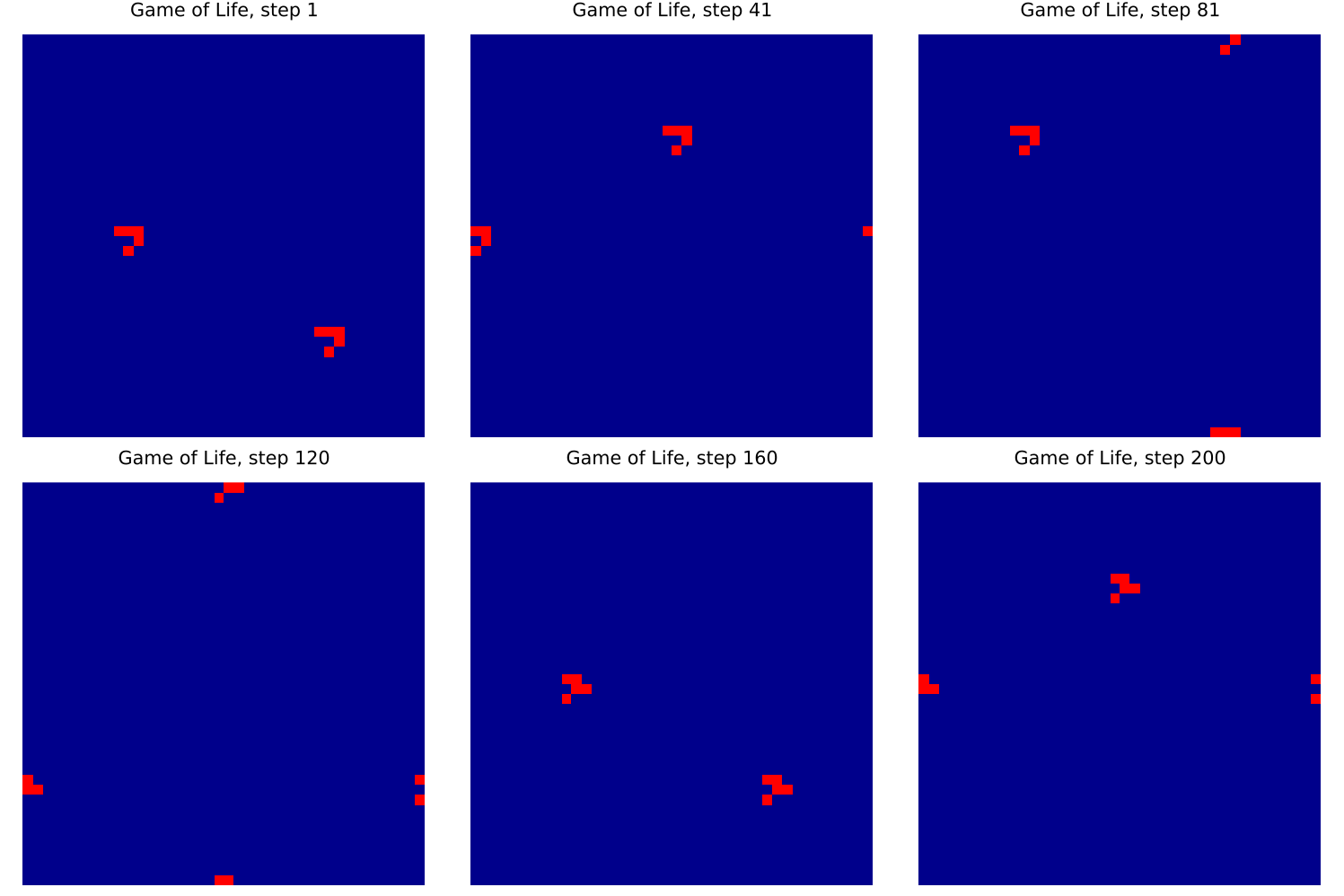 |
| glider gun | 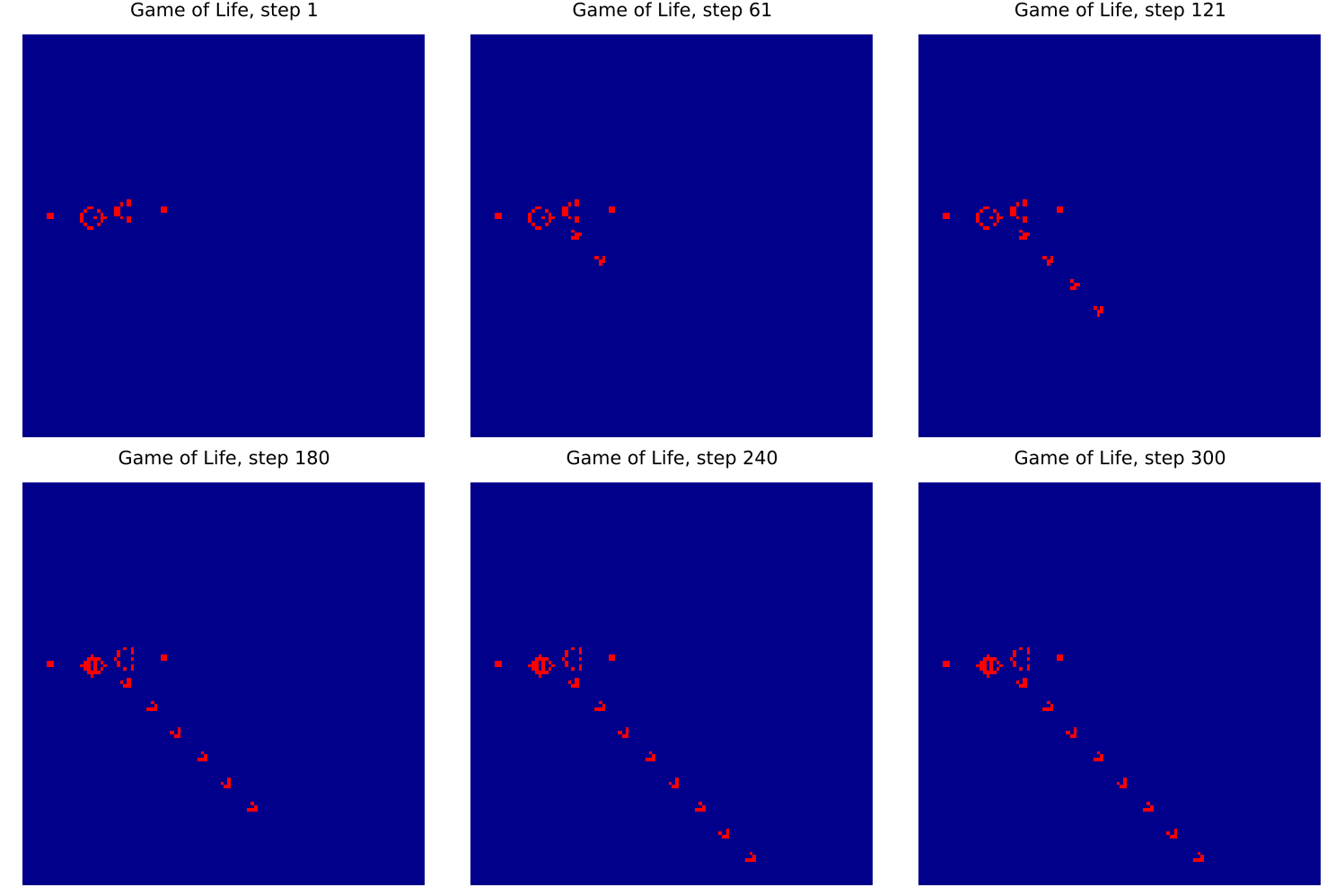 |
Langton Ant
-
What's the observation of the Langton Ant?
-
chaotic phase of about 10000 steps
- form highway
-
walk on highway
-
What's the rule \(R\) for Langton Ant?
| cell state | action |
|---|---|
| white | turn \(90\degree\) left, and paint the cell gray |
| gray | turn \(90\degree\) right, and paint the cell white |
Traffic model
- Consider one-dimension Cellular Automata with \(\mathcal N\) as nearest neighbors. What does \(c=101\) mean?
\(10_{10} = 01100101_{2}\) which stands for rule
| entries | 111 | 110 | 101 | 100 | 011 | 010 | 001 | 000 |
|---|---|---|---|---|---|---|---|---|
| \(\alpha\) | 0 | 1 | 1 | 0 | 0 | 1 | 0 | 1 |
- In above setting, how many possible rules for 1 D Cellular Automata with \(q=3\)?
\(2^8=256\)
- What phenomenon will you observe for number of moving cars when \(c=184\)
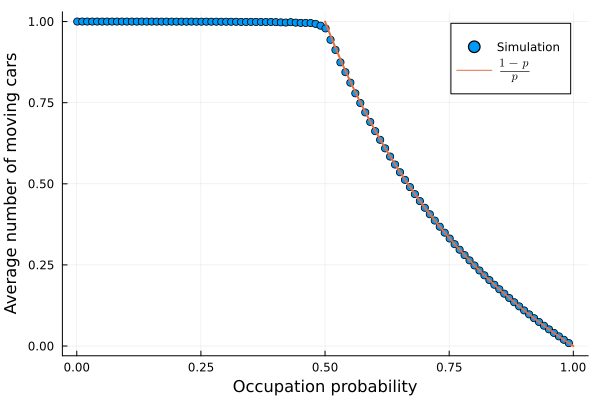
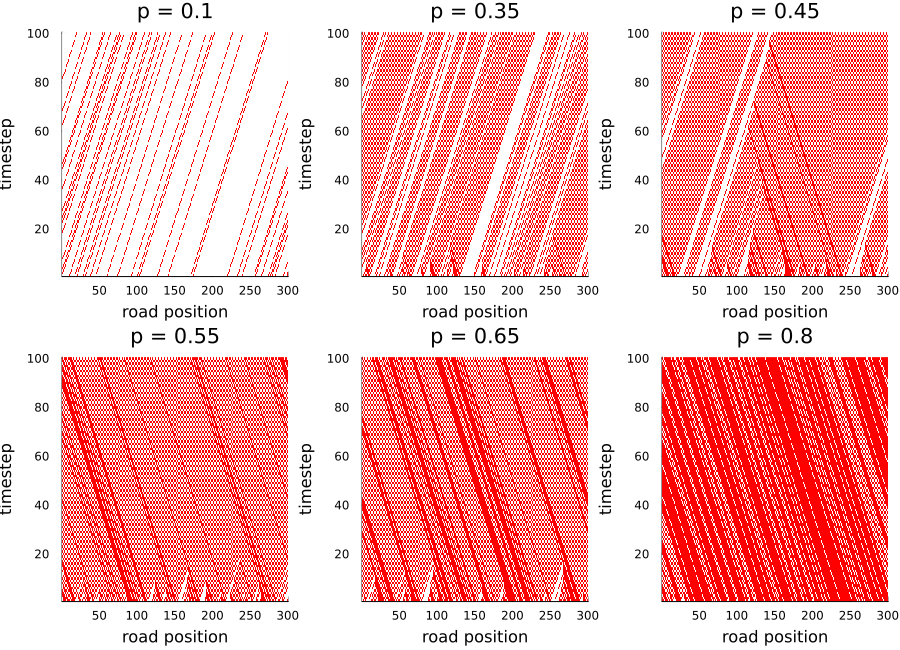
when \(p>0.5\), traffic jam will happen
HPP model
- What does the HPP lattice look like?
HPP lattice is defined on a 2d square lattice, also one could use hexagonal grid with two possible result
- Describe the steps of HPP model.
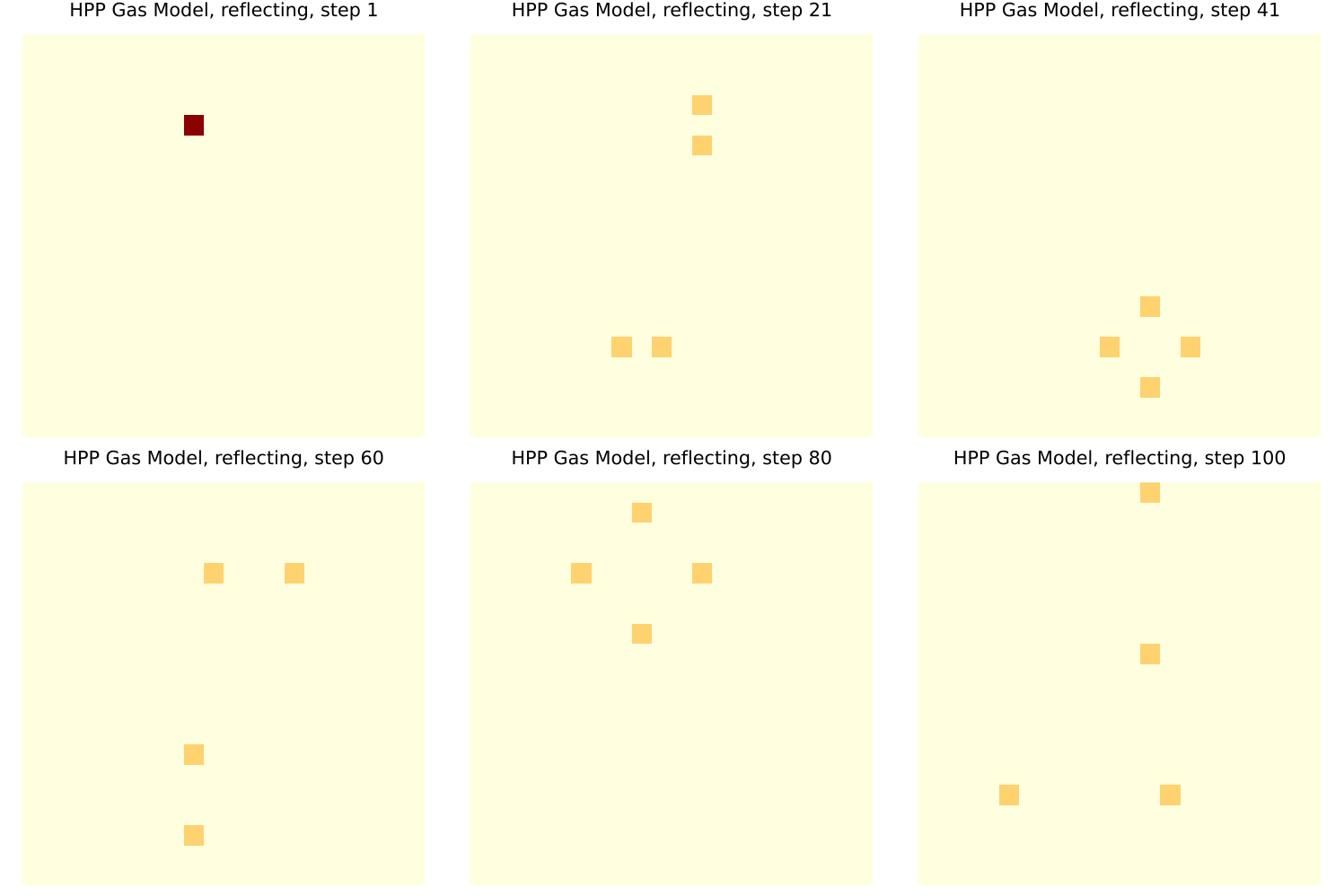
- collision
- propagation/streaming
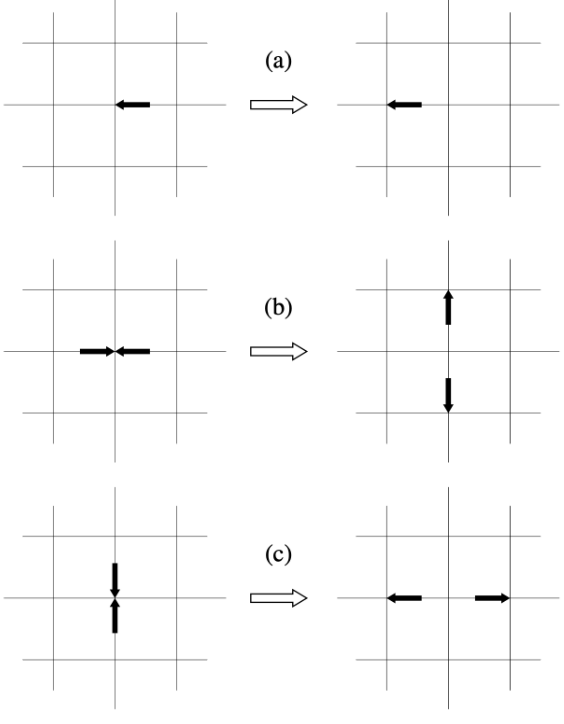
- How many bits of information at each site are enough for HPP model ?
4, \(\psi(r,t)=(1011)\): three particles entering the site in direction 1,3,4
5. Monte Carlo
-
the main steps of a MC method?
-
random choose a new configuration in phase space,
-
accept or reject new configuration,
-
compute physical quantity and add it to the averaging procedure,
-
repeat
-
with is the error \(\Delta\) of MC? is it depend on the dimension?
\(\Delta \propto \frac{1}{\sqrt{N}}\), no
Buffon's Needle
- Suppose the length of the needle is \(l\) and distance of grid is \(t\). What is the probability of the needle cross the line?
\(2l / (πt)\)
Integration
- when simple sampling MC integration works well?
when \(g(x)\) is smooth
- what's the error of conventional integration(Trapezoidal Rule) ?
\(\Delta \propto N^{-\frac{2}{d}}\)
- What's the error in simple MC integration?
\(\Delta \propto \frac{1}{\sqrt N}\), it's independent of the dimension \(d\)
- What's the curcial points for MC method(MC more efficient than conventional method)?
\(d_{crit} = 4\)
-
Describe the steps for high dimension integration using MC.
-
choose particle position
-
make sure new sphere not overlap with pre-existing spheres. If it overlap, reject and sample again
-
Given a distribution \(g(x)\) better enclose the \(f(x)\), describe the steps for sampling better \(x\)
-
\(u\sim P_u(0,1)\)
- \(x=G^{-1}(u), G(x)=\int g(x)dx\)
- \(y = P_u(0,g(x))\)
- if y > \(f(x)\) try again, else return \(x\)
Importance Sampling
- Given the \(x\) sampling from \(g(x)\) which is better enclose \(f(x)\), how to integrate \(f(x)\) using Importance Sampling? $$ I\sim \frac{1}{N}\sum_{i=1}N\frac{f(x_iG)}{g(x_i^G)} $$
Control Variate
-
What is Control Variate? $$ I = \int_a^b f(x)dx = \int_a^b(f(x)-g(x))dx +\int_a^b g(x)dx $$
-
If I want to use control variates, what condition should \(g(x)\) satisfy
-
\(\text{Var}(f-g)<\text{Var}(f)\Rightarrow 2\text{Cov}(f,g)>\text{Var}(g)\)
- \(\int_a^b g(x)dx\) is known
Quasi Monte Carlo
- What is Quasi Monte Carlo?
use low discrepancy generator to choose \(x\)
-
What's the theoretical error bound for Quasi Monte Carlo? $$ \mathcal O\left(\frac{(\text{log} N)^d}{N}\right) $$
-
Does the convergence for Quasi Monte Carlo faster than theoretical?
yes
- When does Quasi Monte Carlo better than the Monte Carlo?
\(N>2^d\)
Multi Level Monte Carlo
- For a \(L\) level MLMC, the cost/variance/ for each level is \(C_l,V_l\), what's the cost/variance/sample number for MLMC? $$ \mathbb E[P_L ] = \mathbb E[P_0] + \sum_{l=1}^L \mathbb E [P_l - P_{l-1}] $$
$$ N_l = \mu \sqrt{\frac{V_l}{C_l}}\quad C = \sum_{l=1}^L C_l N_l \quad \text{Var} = \sum_{l=1}^L V_l N^{-1}_l $$
6. Markov Chain
-
given the transition probability \(T\) and acceptance probability \(A\), what's the overall probability of a configuration? $$ W(X\to Y) = T(X\to Y)\cdot A(X\to Y) $$
-
What's the master equation for the evolution of the probability ?\(p(X,\tau)\) $$ \frac{p(X,\tau)}{d\tau}=\sum_{Y\neq X}p(Y)W(Y\to X)-\sum_{Y\neq X}p(X)W(X\to Y) $$
-
What's the three condition a Markov Chain should satisfy?
-
Ergodicitty: \(\forall X,Y\quad W(X\to Y)>0\)
- Normalization: \(\sum_Y W(X\to Y)=1\)
-
Homogeneity: \(\sum_Y p(Y)W(Y\to W)=p(X)\)
-
What's Detailed Balance ?
\(\frac{dp(X,\tau)}{d\tau}=0\) steady state of the Markov process
M(RT)\(^2\) Algorithm
-
What's Metropolis algorithm? $$ A(X\to Y) = \text{min}\left(1,\frac{p_{eq}(Y)}{p_{eq}(X)}\right) $$
-
What's M(RT)\(^2\) algorithm?
-
randomly choose configuration \(X_i\)
- compute \(\Delta E=E(Y)-E(X)\)
- \(A(X\to Y) = \text{min}\left(1,exp(-\frac{\Delta E}{\kappa_BT})\right)\)
if \(\Delta E <0\) it will always accept
- What's the equilibrium distribution of the M(RT)\(^2\) algorithm ?
the Boltzmann distribution $$ p_{eq} = \frac{1}{Z_T}e^{-\frac{E(X)}{\kappa_BT}} $$
Ising Model
- Describe the Ising Model
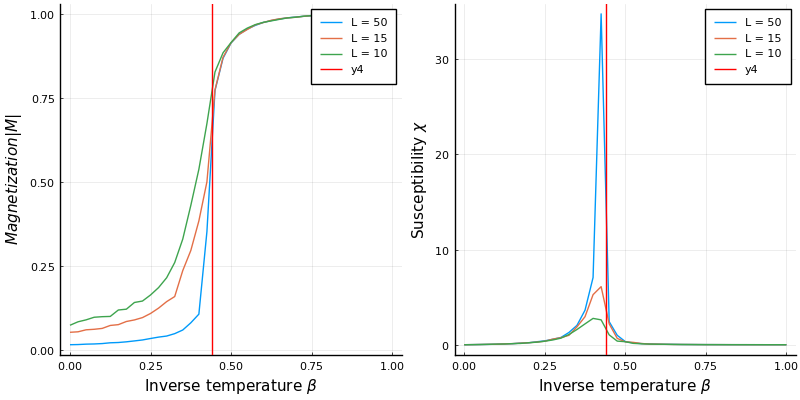
$$ \mathcal H = -J\sum_{\braket{\sigma_i,\sigma_j}}\sigma_i \sigma_j - H\sum_{\sigma_i}\sigma_i $$
\(M\) : magnetization, a particle spin up \(1\) else \(-1\)
\(\chi\) : susceptibility, \(\chi=\frac{\partial M}{\partial H}= \text{Var}(M)\beta\)
\(\beta\) : inverse temperature, \(\beta = \frac{1}{T\kappa_B}\)
-
How to apply M(RT)\(^2\) algorithm to Ising Model
-
randomly choose configuration \(X_i\)
- compute \(\Delta E=E(Y)-E(X)=2J\sigma_i\sigma_j\)
-
\(A(X\to Y) = \text{min}\left(1,exp(-\frac{\Delta E}{\kappa_BT})\right)\)
-
What is the critical temperature for Ising Model ?
\(T_c = \frac{2}{\text{log}(1+\sqrt{2})}\)
6. Finite Difference
Error Estimation
-
How many kinds of errors can be categorized?
-
input data error
- computational rounding error : float point
- truncation error : infinite term/linear approximation
- mathematical model error : flawless assumption
-
human&machine error
-
Are mathematically equivalent formulas also numerically equivalent? why?
no, for example \(|(1+\frac{1}{n})^n-e|\) and \(|\text{exp}(n\text{log}(1+\frac{1}{n}))-e|\)
-
What is error propagation? How to compute it? $$ |\Delta f|\lesssim \sum_{i=1}^n\left|\frac{\partial f}{\partial x_i}\right||x_i| $$
-
What is ill-conditioned and well-conditioned ?
ill-conditioned : small changes in the input data can result in large changes in the output data
well-conditioned : small changes in the input data only result in small changes in the output data
Discretization in Space and Time
- What's the parabolic/hyperbolic/elliptic form?
- parabolic: \(D\frac{\partial^2 \phi}{\partial x^2} - \frac{\partial \phi}{\partial t}=0\)
- hyperbolic: \(\frac{\partial^2 \phi}{\partial x^2}-\frac{1}{c}\frac{\partial^2 \phi}{\partial t^2} = 0\)
- elliptic: \(\nabla^2 \phi = 0\)
FTBS
-
What is Forward in Time, Backward in Space? $$ \begin{aligned} \frac{\partial \phi}{\partial t}&=\frac{\phi_j{n+1}-\phi_jn}{\Delta t} +\mathcal O(\Delta t)\ \frac{\partial \phi}{\partial x}&=\frac{\phi_jn-\phi_{j-1}n}{\Delta x}+\mathcal O(\Delta x) \end{aligned} $$
-
What is the order of accuracy for FTBS?
first order accuracy
- Assume \(c=\frac{u\Delta x}{\Delta t}\), when is FTBS stable and when is it unstable?
the Domain of Dependence(DoD) for FTBS is \(c\in[0,1]\), within the DoD the domain is stable.
- Solving the linear advection condition \(\phi_t+u\phi_x=0\) with FTBS, what is the \(|A|^2\) in Von-Neumann Stability? $$ \begin{aligned} \phi_j^n &= A^n e^{ikj\Delta x} \ A &= 1-c(1-e^{-ik\Delta x}) \ |A|^2 &= 1-2c(1-c)(1-cos k\Delta x) \end{aligned} $$
FTCS
-
What is Forward in Time Center in Space ? $$ \begin{aligned} \frac{\partial \phi}{\partial t}&=\frac{\phi{n+1}-\phi +\mathcal O(\Delta t)\ \frac{\partial \phi}{\partial x}&=\frac{\phi_{j+1}-\phi_{j-1}}{\Delta x}+\mathcal O(\Delta x^2) \end{aligned} $$}}{\Delta t
-
Solving the linear advection condition \(\phi_t+u\phi_x=0\) with FTCS, what is the \(|A|^2\) in Von-Neumann Stability? What's different from FTCS? $$ |A|^2 = 1+4c^2 \text{sin}^2(k\Delta x) $$
CTCS
-
What is Centred in Time, Centred in Space ? $$ \begin{aligned} \frac{\partial \phi^n_j}{\partial t} &= \frac{\phi_j{n+1}-\phi_j+\mathcal O(\Delta t^2) \ \frac{\partial \phi_j^n}{\partial x} &= \frac{\phi_{j+1}}}{2\Delta tn-\phi_{j-1}n}{2\Delta x} +\mathcal O(\Delta x^2) \end{aligned} $$
-
How to get the second term \(\phi^1\)
use FTCS
- Assume \(c=\frac{u\Delta x}{\Delta t}\), when is CTCS stable and when is it unstable?
The DoD for CTCS is \(c\in[-1,1]\), within the DoD, it's stable.
-
Solving the linear advection condition \(\phi_t+u\phi_x=0\) with CTCS, what is the \(|A|^2\) in Von-Neumann Stability? What's different from FTBS? $$ A = -ic \text{sin}k\Delta x \pm\sqrt{1-c2sin2k\Delta x} $$
-
The solution is stable and not damping since \(|A|^2=1\Leftrightarrow |c|\le 1\)
- There are two solutions, one is spurious computational mode, one is the realistic solution
BTCS
-
What is Backward in Time, Centred in Space? $$ \begin{aligned} \frac{\partial \phi^{n+1}j}{\partial t} &= \frac{\phi_j{n+1}-\phi_j+\mathcal O(\Delta t) \ \frac{\partial \phi_j^{n+1}}{\partial x} &= \frac{\phi}}{\Delta t{n+1}-\phi_{j-1} +\mathcal O(\Delta x^2) \end{aligned} $$}}{2\Delta x
-
Is BTCS implicit?
yes
Numerical Analysis
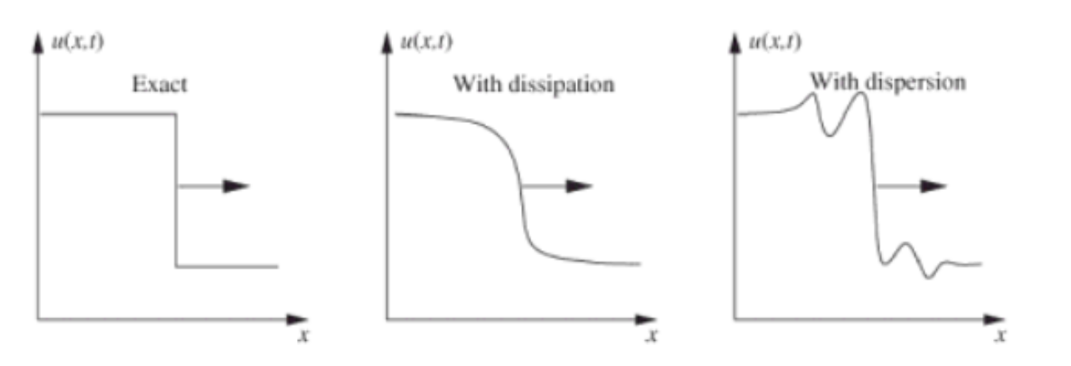
- What is Numerical diffusion and Numerical dispersion?
Numerical diffusion: smooth out sharp corners
Numerical dispersion: Fourier components travel at different speeds
- What is Lax-Equivalence Theorem?
$$ \text{consistency}+\text{stability}\Leftrightarrow \text{convergence} $$
-
What is Courant-Friedrichs-Lewy(CFL) criterion? What's the CFT condition for linear advection \(\phi_t +u\phi_x = 0\)? $$ C = \frac{u\Delta t}{\Delta x}\le C_{max} $$
-
What's the typical \(C_{max}\) for explicit method and implicit method?
\(C_{max}=1\) for explicit method, \(C_{max}>1\) for implicit method
- What is Von-Neumann Stability Analysis?
$$ \phi{n+1}=A\phin\quad A\in \mathbb C $$
| condition | behavior |
|---|---|
| \(\|A\|^2<1\) | stable and damping |
| \(\|A\|^2=1\) | neutral stable |
| \(\|A\|^2 > 1\) | unstable and amplyfying |
Phase velocity
- What is the phase velocity in linear advection \(\phi_t+u\phi_x = 0\)?
\(u\) since \(\phi(x,t)=\phi(x-ut,0)\)
- What is the amplification factor \(A\) of linear advection analytical solution?
\(A=e^{-iku\Delta t}\)
- What is the phase speed for amplification factor \(e^{-i\alpha}\) with wave number \(K\)?
\(\alpha/(k\Delta t)\)
-
What is the amplification factor of CTCS? $$ A = -ic\text{sin}k\Delta x\pm\sqrt{1-c^2 \text{sin}^2k\Delta x} $$
-
What is the phase speed \(u_n\) in linear advection when using CTCS method? What phenomenon do you observe?
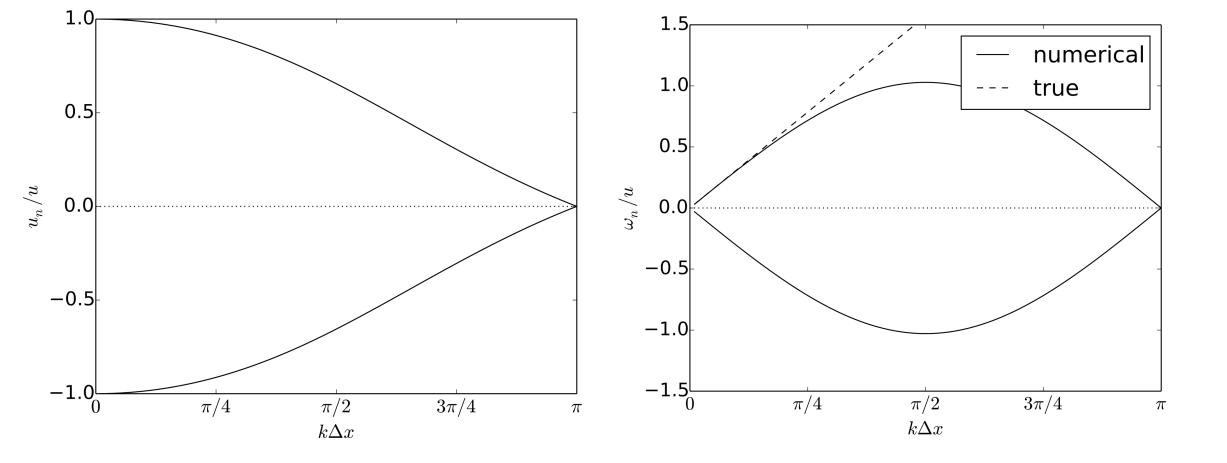 $$
u_n = \frac{1}{k\Delta t}\text{tan}^{-1}\frac{c\text{sin}k\Delta x}{\pm\sqrt{1-c2\text{sin}2k\Delta x}} =\pm\frac{\text{sin}k\Delta x}{k\Delta x}u
$$
$$
u_n = \frac{1}{k\Delta t}\text{tan}^{-1}\frac{c\text{sin}k\Delta x}{\pm\sqrt{1-c2\text{sin}2k\Delta x}} =\pm\frac{\text{sin}k\Delta x}{k\Delta x}u
$$
- There are two solutions, the positive one is the physical mode.
- The physical mode is close to the ground truth when \(k\) and \(\Delta x\) is very small.
Shallow water equation
-
What is the equation for incompressible navier stokes? $$ \begin{aligned} \frac{\partial v}{\partial t} + (v\cdot \nabla) v &= -\frac{1}{\rho}\nabla p + g \ \nabla\cdot v &= 0 \end{aligned} $$
-
Assume the gravity only in \(z\) direction, what PDE equation can we get from the incompressible navier stokes? How about 1D condition? $$ \begin{aligned} \frac{\partial H'}{\partial t} &= -H_0\left(\frac{\partial \int_{-H0}+\frac{\partial \int_{-H} v_x dz}{\partial x0}\right) \ \frac{\partial \int_{-H} v_y dz}{\partial y0} \ \frac{\partial \int_{-H} v_x dz}{\partial t} &= -g \frac{\partial H'}{\partial x0} \end{aligned} $$} v_y dz}{\partial t}&=-g\frac{\partial H'}{\partial y
1 D condition $$ \begin{aligned} \frac{\partial H'}{\partial t} &= -H_0\frac{\partial \int_{-H0} \ \frac{\partial \int_{-H} v_x dz}{\partial x0} \end{aligned} $$} v_x dz}{\partial t} &= -g \frac{\partial H'}{\partial x
- In 1 D wave condition, assume \(u= \int_{-H^0}^{H'}v_x dz\) and \(\eta=H'\), give the unstaggered(A-grid) and staggered(C-grid) formular of centered in space. Assume \(c = \sqrt{gH_0}\frac{\Delta t}{\Delta x}\), what are the stable conditions for them?
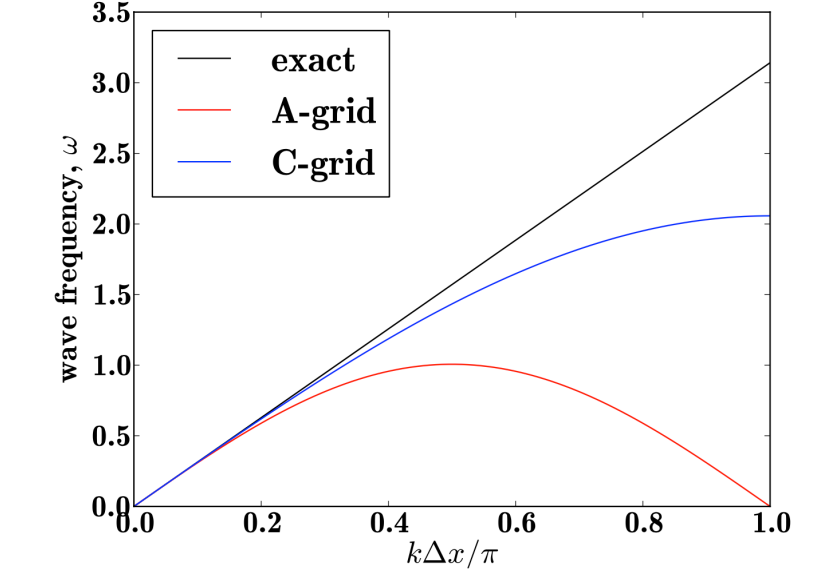
A-grid
stable for \(c\le 2\) $$ \frac{\eta^n_j - \eta^{n-1}j}{\Delta t} = - H_0 \frac{u^n \ \frac{u^{n+1}} - u^n_{j-1}}{\Delta xj - u^n_j}{\Delta t} = -g \frac{\eta^n $$ C-grid} - \eta^n_{j-1}}{\Delta x
stable for \(c\le 1\)
better at high frequency $$ \frac{\eta_j^n- \eta^{n-1}j}{\Delta t} = - H_0\frac{un_{j+\frac{1}{2}}-un \ \frac{u^{n+1}}}{\Delta x{j+\frac{1}{2}} - u^n $$}{2}}}{\Delta t} = - g \frac{\eta^n_{j+1} - \eta^n_{j-1}}{\Delta x
7. Time Integration
Error
- What's the difference between truncation error and round-off error?
Truncation error results from Taylor expansion
Roundoff error results from the float point computation
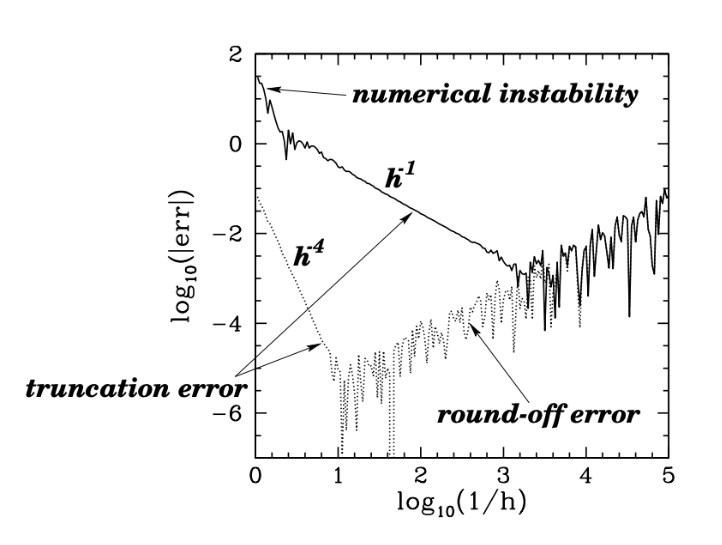
- What is the round off error for explicit euler of timestep \(\Delta t\)?
\(\mathcal O\left(\frac{\eta}{\Delta t}\right)\) where \(\eta=\text{eps}(\text{float})\)
- What is the truncation error for explicit euler of timestep \(\Delta t\)?
\(\mathcal O(\Delta t)\)
-
What are the two main drawbacks of explicit euler compared to rounge kutta method?
-
it's numerical instable
-
it has first order of truncation error which is lager then rounge kutta
-
Describe the picture below.
Conservation
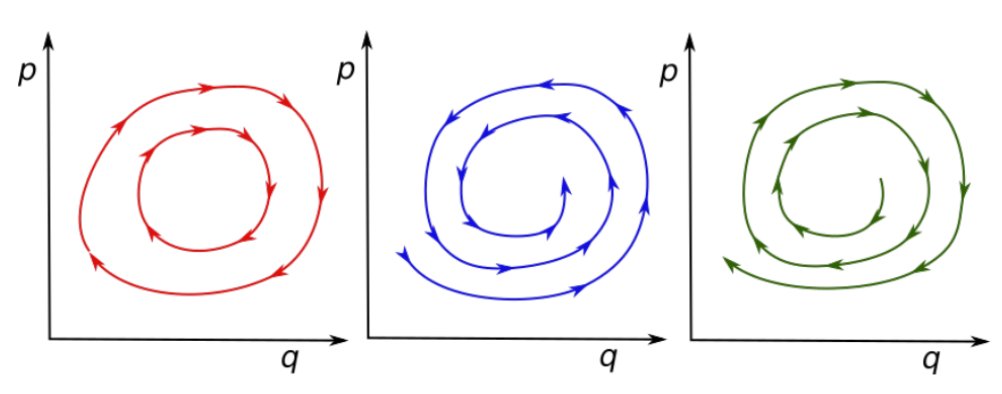
- What is Symplectic?
\(|\text{det}(A)|=1\)
- Given Hamitonian transformation \(A=\begin{bmatrix}\text{cos}\tau&\text{sin}\tau\\-\text{sin}\tau&\text{cos}\tau\end{bmatrix}\) that \(\begin{bmatrix}q'\\p'\end{bmatrix}=A\begin{bmatrix}q\\p\end{bmatrix}\), what is the modified Hamitoninan transformation for the first order of \(\tilde A\)?
\(\begin{bmatrix}1&\tau\\-\tau&1-\tau^2\end{bmatrix}\)
- Describe the picture below from the conservation view.
8. Maxwell Equation
- Give the general formula of Vlasov-Maxwell-Boltzmann equation describing the plasma distribution \(f(\textbf{x},\textbf{v},t)\in \R^{3\times 3\times 1}\). $$ \begin{aligned} \frac{\partial f}{\partial t} &+ \nabla_\textbf{x} \cdot(\textbf{v}f) + \nabla_\textbf{v}\cdot (\textbf{F}f) = \left(\frac{\partial f}{\partial t}\right)_c \ \textbf F &= \frac{q}{m(\textbf{E}+\textbf{v}\times \textbf{B})} \end{aligned} $$
\(\nabla_\textbf{x}\cdot (\textbf{v}f)\) : advection in real space
\(\nabla_\textbf{v}\cdot (\textbf{F}f)\) : advection in velocity space
\(\textbf F = \frac{q}{m(\textbf{E}+\textbf{v}\times \textbf{B})}\) : lorentz force
\(\left(\frac{\partial f}{\partial t}\right)_c\):collision term, normally \(0\) in Vlasov equation
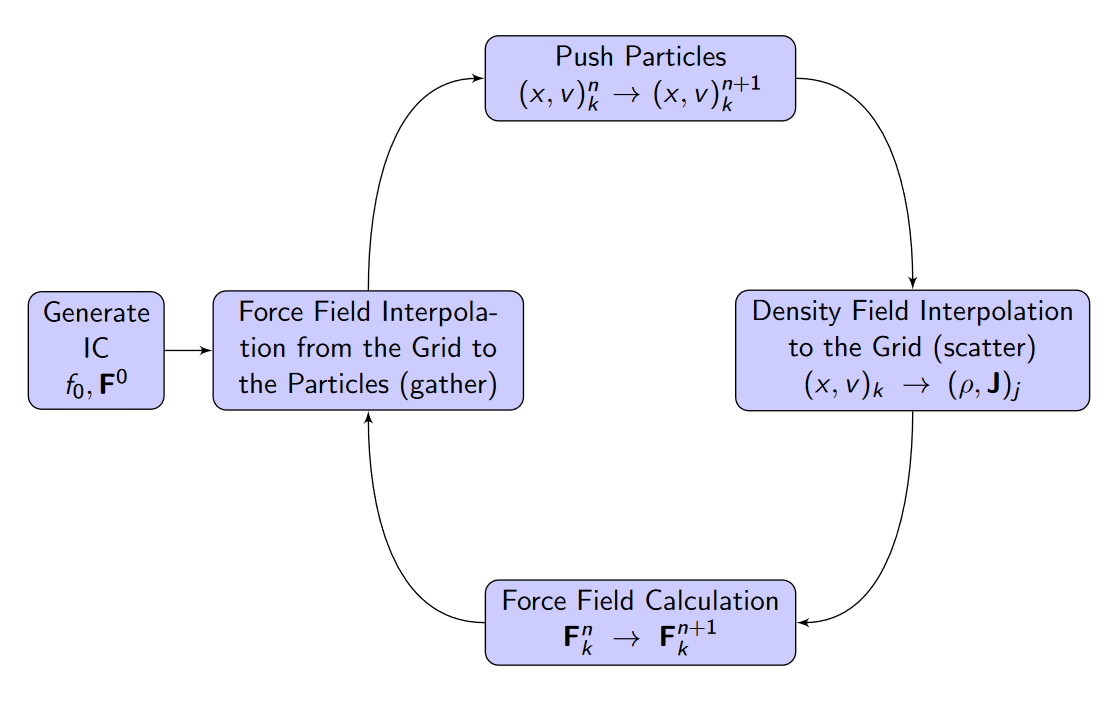
particle in cell
- Describe the Particle in Cell(PIC) method. $$ \begin{aligned} \frac{d\boldsymbol x}{dt} &= \boldsymbol v\ \frac{d\boldsymbol v}{dt} &= \frac{q}{m}(\boldsymbol E(\boldsymbol x,t), \boldsymbol v\times \boldsymbol B(\boldsymbol x, t)) \end{aligned} $$
Boris Algorithm
-
Describe the Boris Algorithm. $$ \begin{aligned} \textbf{v}^- &= \textbf{v}^{n-\frac{1}{2}} + \frac{q}{m} \boldsymbol E^n\frac{\Delta t}{2} \ \textbf{t} &= \text{tan}\left(\frac{qB\Delta t}{2m}\right)\frac{\textbf{B}}{B} \approx \frac{q\textbf{B}\Delta t}{2m} \ \textbf{s} &= \frac{2t}{1+|t|^2} \ \textbf{v}' &= \textbf{v}-+\textbf{v}-\times\textbf{t} \ \textbf{v}^+ &= \textbf{v}^- + \textbf{v}'\times \textbf{s} \ \textbf{v}^{n+\frac{1}{2}} &= \textbf{v}^+ + \frac{q}{m}\boldsymbol E^n\frac{\Delta t}{2} \end{aligned} $$
-
Show what the absence of \(\textbf{E}\) of the Boris algorithm conserves kinetic energy.
Yee-cell
- Describe the Yee-Cell method.
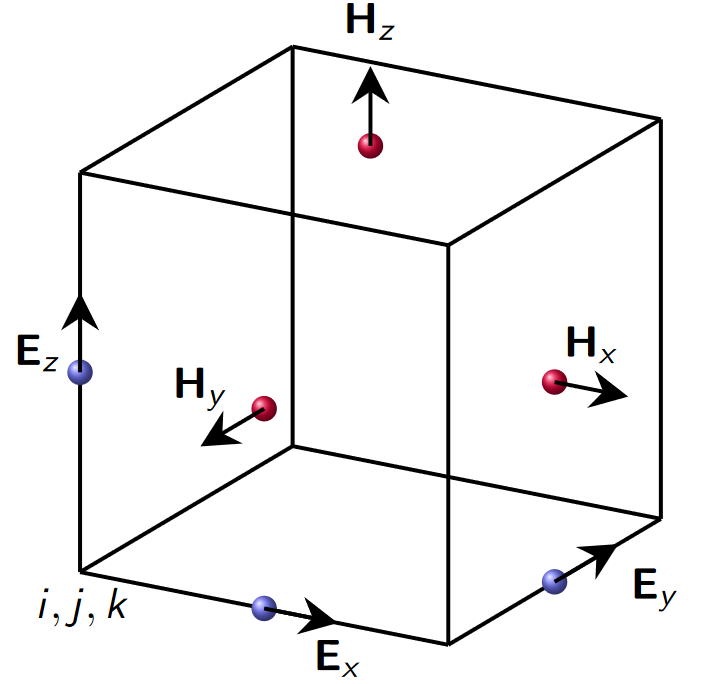 $$
\frac{E_{x_k}{n+\frac{1}{2}}-E_{x_k}
\
\frac{H_{y_{k+\frac{1}{2}}}}{2}}}{\Delta t} = -\frac{1}{\varepsilon_0}\frac{H_{y_{k+\frac{1}{2}}}^n - H_{y_{k-\frac{1}{2}}}^n}{\Delta z{n+1}-H_{y_{k+\frac{1}{2}}}n}{\Delta t} = -\frac{1}{\mu_0}\frac{E_{x_{k+1}}{n+\frac{1}{2}}-E_{x_k}
$$
}{2}}}{\Delta z
$$
\frac{E_{x_k}{n+\frac{1}{2}}-E_{x_k}
\
\frac{H_{y_{k+\frac{1}{2}}}}{2}}}{\Delta t} = -\frac{1}{\varepsilon_0}\frac{H_{y_{k+\frac{1}{2}}}^n - H_{y_{k-\frac{1}{2}}}^n}{\Delta z{n+1}-H_{y_{k+\frac{1}{2}}}n}{\Delta t} = -\frac{1}{\mu_0}\frac{E_{x_{k+1}}{n+\frac{1}{2}}-E_{x_k}
$$
}{2}}}{\Delta z
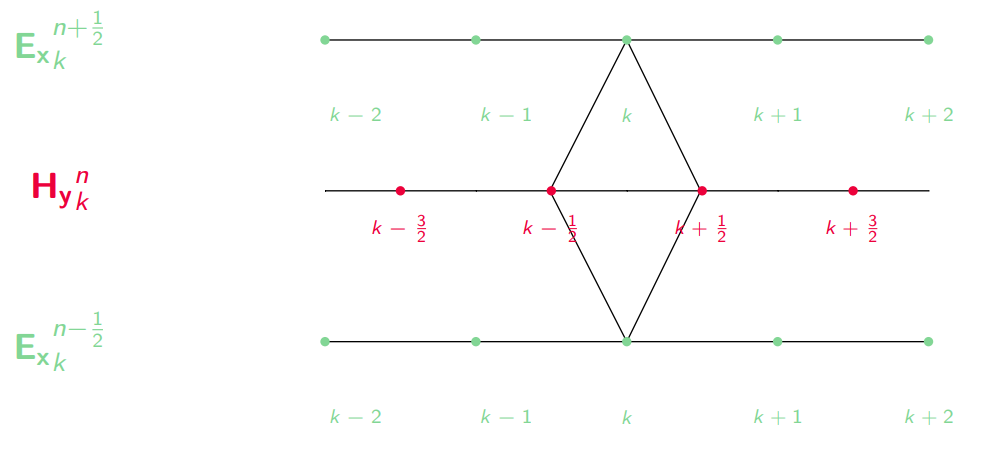
- How to determine the time step \(\Delta t\)?
\(\Delta t = \frac{\Delta x}{\sqrt{d}c}\) where \(d\) is dimension
- How to minimize the error of by scaling \(E_x\) ?
\(\tilde E_x = \sqrt{\frac{\varepsilon_0}{\mu_0}}E_x\)
9. Nbody Problem
- List some algorithm to solve n-body problem numerically.
- PIC(Particle in Cell) : grid field solver
- P3M(Particle-particle Particle-Mesh) : split forces into short and long range
- Langevin : using Rosenbluth potentials
- SPH(Smooth Particle Hydrodynamics) : between finite sized
- FMM(Fast multipole method) : use center of force
- Tree Methods : mesh free
PIC(Particle In Cell)
P3M(Particle-Particle Particle-Mesh)
- Describe the general idea of P3M algorithm.
- nearby particles - nbody calculation \(\mathcal O(n^2)\)
- fa away particles - PIC algorithm \(\mathcal O(n)\)